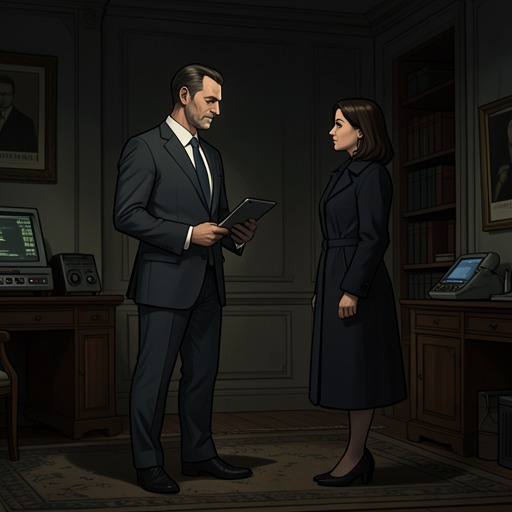
The Founding of the Grafters
The RookThe Founding of the Grafters begins not with a declared institution but with a family visit, a knife, and a severed finger. In Ernst von Suchtlen’s account to Myfanwy, his cousin Gerd’s impossible demonstration changes a private meeting into a business proposition: the experiments that restore damaged bodies might also replace Ernst’s missing lower leg. Ernst supplies the money and formal agreements that allow the researchers’ work to continue, and later relocates it to an estate of his own.
The story Ernst tells
The account is embedded in a later conversation. Myfanwy has just reflected that she may have retained some of Rook Thomas’s diplomatic skill; Ernst settles back and tells her a story. The founding therefore reaches the reader as a participant’s recollection, not as an impersonal institutional record. Its decisive turn is also retrospective: what first appears to Ernst as a disturbing episode with a knife becomes, once he sees what the experiments can do, the start of a venture.
Ernst places the meeting in mid-autumn, eight months after an accident involving a frightened horse and sharp rocks cost him the lower half of his left leg. He is thirty-eight, wealthy, and living in a country house. The loss belongs to a year already marked by family grief and material difficulty: one sister has died in childbirth, and a fire has destroyed the homes of several tenants. At the same time, Ernst has had successful financial ventures and is considering leaving politics to marry and have children. This mixture of injury, bereavement, wealth, and possible retreat from public life gives the prospect of a new leg a concrete personal urgency.
Gerd’s demonstration
Gerd arrives on horseback. He is ten years younger than Ernst, less wealthy, and has suffered losses in unsuccessful ventures, including an elaborate con. He has borrowed money from Ernst before and been slow to repay it. Ernst is fond of him nonetheless: they are family, and they have previously enjoyed hunting together. That history helps explain why Ernst receives him despite anticipating another request for money, while also sharpening the unease when Gerd proposes an investment that could redefine their future.
During their conversation by the fire, Gerd draws a belt knife. Ernst notices the gesture, dislikes Gerd’s use of “our,” and reaches for his own knife. Gerd then cuts off his own forefinger. The horror is not merely the sudden mutilation: the severed finger and the wound both turn sky blue. Ernst is preparing to call for help, uncertain whether Gerd needs to be restrained or the blood cleaned, when Gerd holds up the finger and brings it back to his hand. Blue tendrils reach between the two surfaces; after a faint sucking sound, the hand is whole again. The finger’s restoration is the proof that makes Gerd’s extravagant proposal materially credible.
The scene briefly leaves Ernst unsure whether his cousin has dealings with the devil. Yet fear gives way to interest once he considers that the phenomenon might not be an abomination leading to damnation, but a business opportunity. The reversal is central to the origin story: the same bodily spectacle that threatens to repel Ernst persuades him to invest. His response does not erase his alarm; he proceeds with caution, taking two large men from his estates as backup when he visits Gerd’s residence.
Experiments, funding, and relocation
At Gerd’s residence, Ernst finds a handful of grubby men conducting complicated experiments in a barn. Their social awkwardness and absorption in their work make them seem unlike recruiters for a diabolical cause. They explain what they are doing over several hours. Ernst finds the explanations taxing, but one possibility cuts through the complexity: they believe they can provide him with a new leg.
He watches the researchers cut mice, hounds, and horses in half and join them back together. For Gerd, the work inspires fascination; for Ernst, it opens a field of possibilities. They agree that Ernst will fund the research, while the researchers sign several binding contracts. The distinction matters to the episode’s account of the Grafters’ beginnings: the work has a scientific and experimental dimension, but it also takes shape through money, negotiated obligations, and control of where the work is done. After the agreement, the researchers continue their experiments, which are later moved to one of Ernst’s more remote properties.
Significance and limits of the origin account
Ernst closes the story by calling this the beginning of it all. The origin is presented as a sequence of decisions rather than as a formal founding ceremony: Gerd demonstrates bodily restoration, Ernst identifies its potential, and financing and contracts give the experiments a continuing base. The researchers’ work on several kinds of animals also shows that the enterprise’s early promise is broader than Ernst’s individual need, even though the prospect of replacing his leg is what most directly excites him.
The scene is framed by its later consequences without narrating them in detail. Myfanwy observes that, centuries later, Ernst is sitting naked in her chair; Ernst replies that the Checquy has thoroughly documented the subsequent history, including the Grafters’ rise to power, their connection to the government, an attempt at conquest, and their forcible dismantling. The founding story thus sets intimate bodily repair beside the political scale of what followed. But within Ernst’s own account, the point of origin remains strikingly practical: an injured man sees a chance to recover a lost part of his body, and his investment helps turn a barn of experiments into the beginning of a much larger history.